









Lorenzo Riches
July 1, 2026
Share this post
Solcast's solar forecasts are built on an ensemble of models trained on our proprietary satellite-derived actuals, which use numerical weather prediction (NWP) data as inputs. For the +4h to +48h window that is essential to intra-day and day-ahead dispatch operations and planning, we have now added a new member to that ensemble: a deep-learning model that uses an attention mechanism to correct the systematic errors even the best physics-based models leave behind. In North America, where this change is now live, it makes our intra-day and day-ahead forecasts measurably more accurate — delivering an average 9% relative improvement in Global Horizontal Irradiance (GHI) forecast accuracy over the +4h to +48h range, measured against ground station data and relative to the previous Solcast ensemble. Because GHI is the primary input to our PV power forecasts, those forecasts should benefit as well.
What this change adds — and how it fits into the ensemble
The existing Solcast forecast pipeline trains models utilising NWP output from several leading mesoscale and global weather models against our proprietary satellite-derived cloud opacity actuals at ~2 km resolution. NWP models represent atmospheric physics and are exceptionally good at large-scale dynamics and multi-day trends, but their resolution and necessary modelling simplifications, such as parameterization, mean they carry local biases — errors that are systematic rather than random. Combining NWP with our own satellite data helps us correct those errors and provide high-quality forecasts worldwide.
This new model takes it to a new level, targeting those residuals directly. The attention-based model added to our ensemble learns to predict the difference between what the best available mesoscale NWP model says and what Solcast's actuals show, then adds that correction to produce a highly accurate output.
.png)
The architecture is an encoder-decoder deep neural network — the same broad family used in state-of-the-art ML weather models like MetNet and FourCastNet. It runs at the full resolution of Solcast's cloud opacity actuals, downscaling all inputs to ~2 km, which means topographic effects that coarser models smooth over are preserved in the output.
Attention and spatial reasoning
The capability that distinguishes this approach from simpler ML post-processing is its use of an attention mechanism — which enables the network to reason about long-range spatial dependencies without the constraints of a fixed convolutional neighbourhood. Where conventional convolutional layers operate over a fixed spatial neighbourhood, attention allows every position in the feature map to query every other position and learn which spatial relationships are predictively useful. Applied at the bottleneck of the encoder-decoder — where feature maps are at their smallest spatial dimension — the network can reason about long-range dependencies across the full extent of the tile simultaneously.
The model's feature maps are conditioned on location and lead time, allowing it to account for where a forecast is being made and how far ahead each NWP input extends. Because it ingests multiple NWP models issued at different frequencies, the model is trained to explicitly handle different lead-time combinations per NWP source.
In its first release, the model runs over North America using meteorological parameters from ECMWF HRES and NOAA's HRRR as NWP inputs, along with elevation as a static feature. It outputs predicted residuals relative to the NWP baseline, with enforced constraints to preserve the expected physical distribution of irradiance values and ensure stable behaviour at inference time.
This update is optimised for the mean forecast: the best single estimate of expected generation. In the +4h to +48h window, that estimate is often the forecast used for dispatch planning, BESS charge and discharge decisions, and short-term generation planning. Probabilistic forecasts remain valuable where teams need to manage uncertainty, but this update improves the central forecast used in many day-ahead operational workflows.
Hourly issuance: capturing the full value of rapid-refresh NWP
Both our NWP-based forecast engine and this new model now run on hourly issues. Rapid-refresh mesoscale models like HRRR are re-run every hour; a forecasting system that consumes NWP data less frequently leaves meaningful accuracy on the table at short lead times.
Hourly issuance is enabled by an optimised data pipeline: all NWPs are now ingested into cloud-optimised stores, and combined with order-of-magnitude faster inference, Solcast issues a new forecast approximately ten minutes after a new NWP issue is published.
Results: 9% average relative improvement across the +4h to +48h range
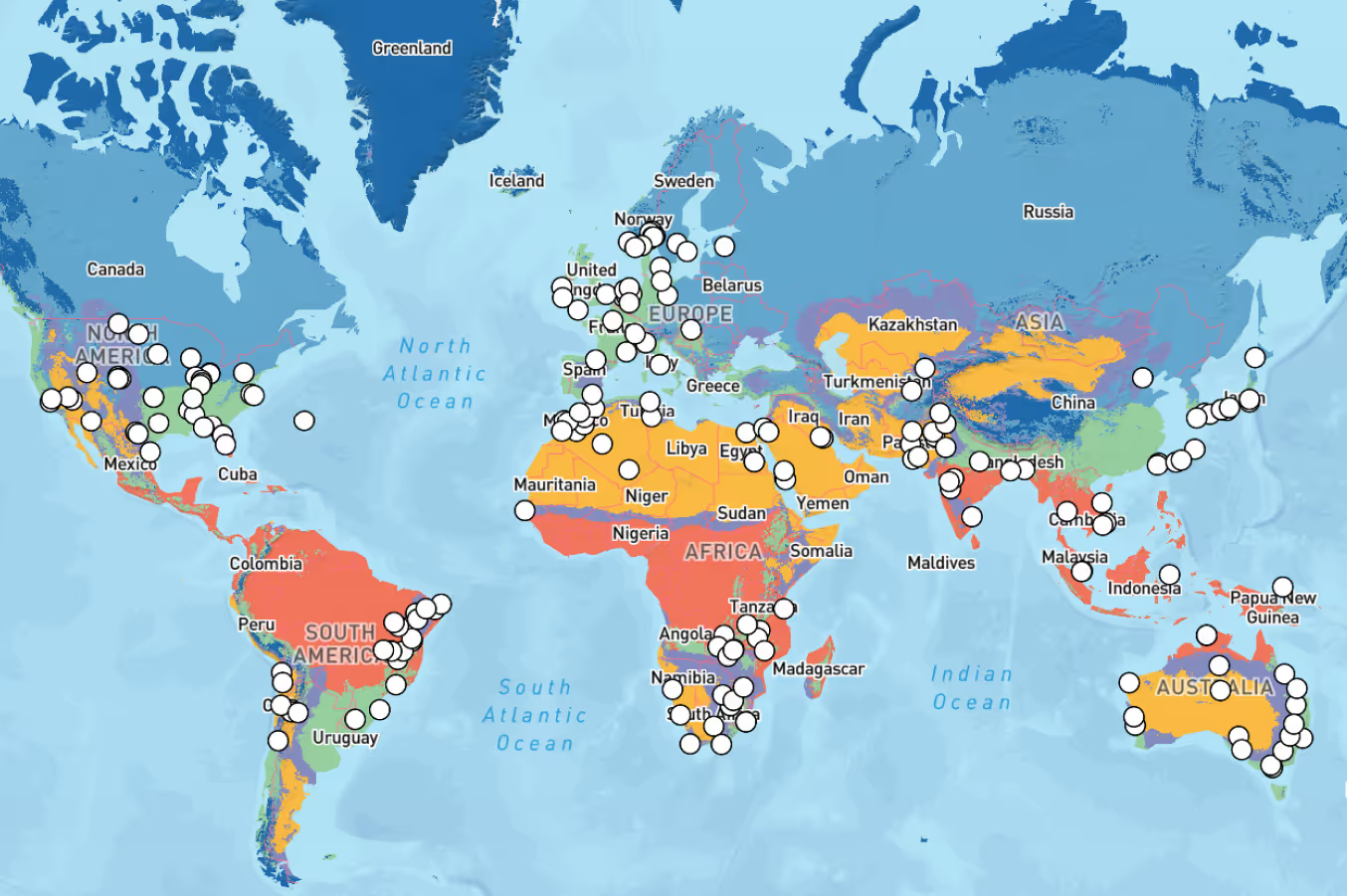
When this change is added to the ensemble over the +4h to +48h range, we observe an average 9% relative improvement in GHI forecasts across all lead times in this range. The PV power forecasts derived from this improved irradiance should also benefit, improving day-ahead generation estimates.
For context on how Solcast validates forecast accuracy, see our forecast accuracy documentation and analysis of ECMWF's AI model for solar forecasting.
What comes next: European rollout
We are now applying the same framework to Europe, using ICON-EU and ECMWF HRES as the primary NWP inputs. As with North America, the European model will undergo thorough evaluation against ground measurements before being pushed to production — we expect to go live within the next couple of months.
If you operate in North America, now is a good time to test — or retest — your day-ahead accuracy against the updated forecasts. Talk to our team if you'd like the detail on what's changed and how it affects your locations.