








Dr. Hugh Cutcher
May 27, 2026
Share this post
What launched
Two new endpoints on the Solcast API: Premium PV Power and Premium Wind Power.
Both deliver site-specific, deterministic and probabilistic power forecasts for operational wind and solar assets. Both are built by DNV's forecasting engineering team — the same people who have spent decades building operational forecasting systems for system operators and asset owners across 20+ countries.
By delivering DNV's forecasting expertise through the Solcast API, we're making site-trained, operationally ready forecasts more accessible and easier to integrate - so you can use high-quality site-trained forecasts deeply integrated into your existing workflows, dashboards, models and tools. If you're operating renewable portfolios with both Solar and Wind, you can use a single API platform to forecast power for every site.
Why Premium PV Power and Premium Wind Power exist
Operators of utility-scale renewable assets face a forecasting problem that benefits from the most accurate forecast possible.
DNV's decades of operational forecasting experience shows that true forecast accuracy comes from matching actual behaviour, not theoretical expectations. Physical models configured from system specifications describe how an asset should perform — not how it actually does. They can't capture site-specific effects like real inverter behaviour, clipping, complex shading, or localised meteorological phenomena. For utility-scale renewable operations, relying on theoretical models over real-world precision translates directly into lost revenue: through costly imbalance penalties, overly conservative bidding that leaves money on the table, and dispatch decisions clouded by unnecessary uncertainty.
.png)
Premium Power closes that gap through a multi-family model ensemble — candidates generated across physical, ML, neural network, and non-linear model families — with DNV's forecasting engineers reviewing and selecting the best configuration for each site. The weather input itself is refined through a site-specific NWP ensemble, not just the power conversion that follows. The result is a forecast that's engineered for your site, maintained by DNV, and updated as your site's performance evolves.
How it works
The Premium PV and Wind modelling pipeline is built independently for each technology, but follows the same modelling pattern, with six stages:
- Multi-model weather ingestion. Multiple global and regional numerical weather prediction (NWP) models are ingested to capture a wide range of atmospheric outcomes. This reduces sensitivity to individual model error — no single weather model dominates the forecast.
- Site-specific weather refinement. The raw NWP data is downscaled and bias-corrected using your site's local measurements. The weather input itself is tuned to your location, not just the power conversion that follows.
- Optimal model blending. Multiple NWP sources are combined to produce the best possible inputs for the power model, using approaches optimised from historical training data.
- Physics-based power conversion. Asset-specific physical and statistical models convert the refined weather data into power output. PV and wind follow different conversion paths, each grounded in the relevant physics.
- Machine learning optimisation. ML models trained using your site’s historical measurements close the gap between the physics-based forecast and what your site actually produced. This captures site-specific effects that no amount of physical parameter tuning can replicate: real inverter behaviour, degradation, shading, equipment interactions in PV, as well as terrain complexity and wind farm layout effects in wind power generation.
- Post-processing and operational adjustments. Customer-supplied availability and curtailment schedules are applied to the forecast outputs.
.png)
The result is a forecast that combines physics and machine learning, trained on your site, updated with your data.
What parameters are available through the API
- Power forecasts in MW — already modelled through the trained power model. Operationally ready power output.
- Probabilistic percentiles — P10, P25, P75, and P90, alongside a central power forecast. These represent uncertainty ranges derived from ensemble spread and statistical methods. They support risk-aware bidding decisions: bid at P10 for conservative revenue protection, the central power forecast for a balanced position, or P90 if your risk appetite allows it.
- 14-day forecast horizon — from +5 minute through to two weeks ahead, at resolutions from 5 minutes to hourly.
- Curtailment handling — time-varying curtailment and availability schedules can be provided.
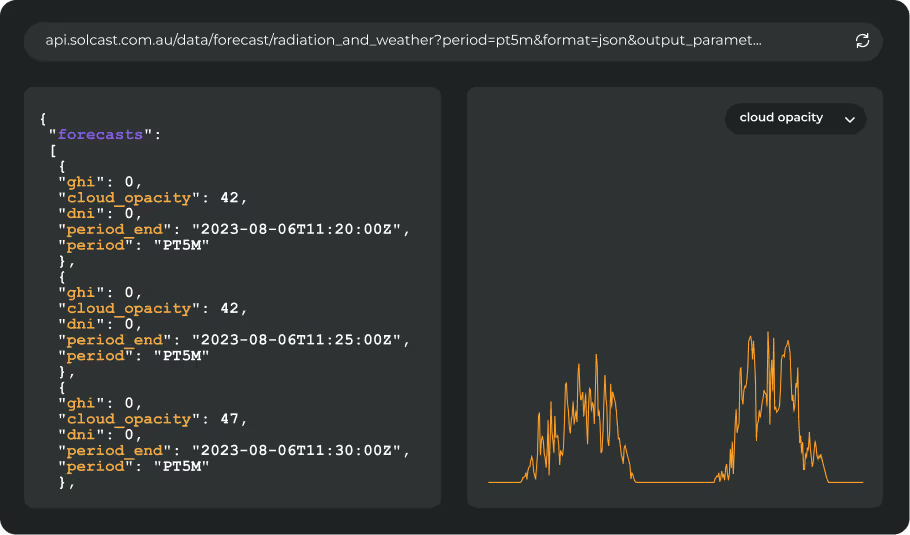
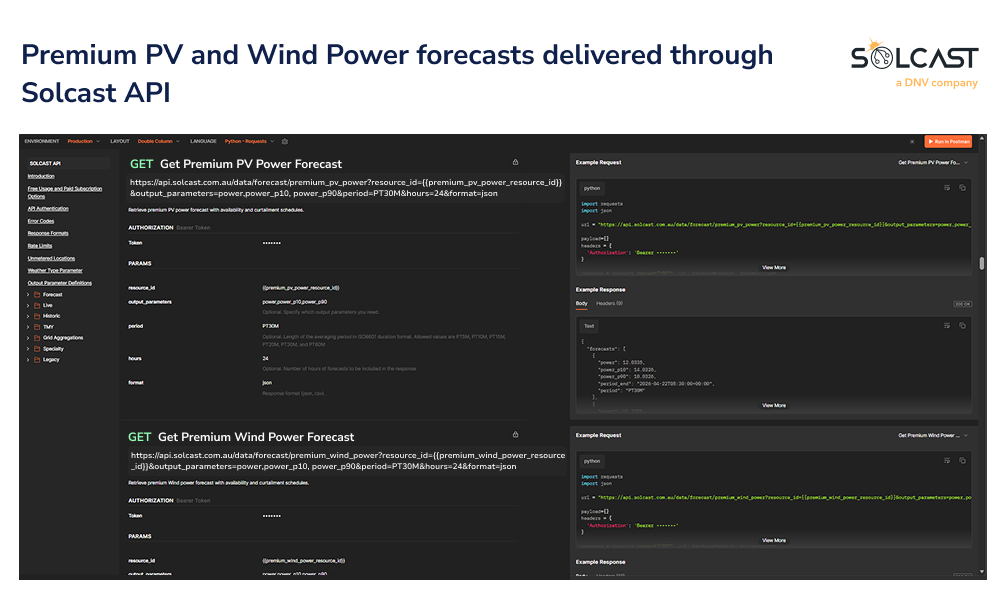
- API delivery — JSON and CSV via the Solcast API. Same authentication, same patterns, same infrastructure that already delivers 26 million+ API calls per day for Solcast's existing customers.
.png)
Wind and solar, available in one platform
Wind power is new for Solcast. It brings DNV's operational forecasting experience — built over decades supporting operators across 20 countries — onto the same platform already delivering PV power forecasts.
For operators managing multi-technology portfolios, this matters. Consistent modelling methodology, consistent uncertainty quantification, consistent data formats across your wind and solar assets. Portfolio-level forecast risk management becomes simpler when you have consistency of model quality and methodology across all managed assets.
Premium Wind Power includes hub-height wind speed and direction alongside power output, supplementing the solar specific weather data already available Probabilistic percentiles are available for both power and wind speed.
Who built this
Premium Power is built by the team behind DNV Forecaster — the same engineers who have delivered operational forecasting systems to system operators, multi-technology IPPs, and asset owners for over 20 years.
That team's track record spans 2,000 wind and solar sites representing 150 GW of installed capacity across six continents. In 2025, the New Zealand Electricity Authority selected the underlying forecasting methodology — through a competitive evaluation process — as the national forecasting standard for all utility-scale wind and solar projects in the country.
Who this is for
Premium Power is designed for operators of utility-scale wind and solar assets — specifically:
- Multi-technology IPPs managing portfolios across wind and solar, often already running ensemble forecasts from multiple providers. Premium Power adds a site-trained, high-quality input to that ensemble — or serves as the anchor forecast.
- Single-asset operators where forecast accuracy has a direct financial impact on bidding, dispatch, or regulatory penalties.
- Operators in markets with imbalance penalties where the difference between a generic forecast and a site-trained forecast translates directly to revenue.
DNV handles model training, validation, selection, and retraining. You provide generation data and engage at key decision points — no need to build an internal data science capability, source NWP models, or run QC pipelines.
Training a site-specific model requires your historical measurement data (minimum 6 months), engineering review, and quality validation. The accuracy you receive is a direct result of the care taken in model training.
What getting started looks like
- You provide at least 6 months historical measurement data and asset configuration
- DNV engineers clean and ingest the data
- The ML modelling pipeline trains and evaluates models for your site
- The training report is reviewed, reconsidered and re-run as many times as required — when accuracy meets the bar, your endpoint goes live
- Forecasts are available via the Solcast API endpoint
For existing Solcast customers, the API integration is the same. New endpoints, same infrastructure.
Data handling
Measurement data you provide is used for model training and forecast improvement for your site only. It is not shared externally or used for any purpose beyond improving your forecast accuracy.
Want to understand what Premium Power can do for your sites?
Talk to one of our DNV and Solcast forecasting experts. Bring your questions about accuracy, model training, and how it fits alongside your existing forecast stack.