








Harry Cheselwoods
April 17, 2026
Share this post
Solcast is updating its Typical Meteorological Year (TMY) dataset to include data from 2025, this change will take effect on the 17th April, 2026. As a result, TMYs generated after this change will not be identical to TMYs generated before the change, because there is new data to select from and long term averages have changed.
This change is expected and reflects the way TMY datasets evolve as the historical record expands. When the underlying long term average changes, the definition of what is “typical” also changes.
Why TMY outputs are changing
TMY data is not a static synthetic profile. It is constructed from real historical observations, selecting representative months from the available archive to produce a year that is statistically typical of long-term conditions.
When 2025 is added to the TMY reference window, the data used will shift from 2007–2024 to 2007–2025. This affects TMY generation in two important ways.
1. More real data is available for month selection
A TMY is built by selecting real months from the historical archive that best match the target long-term statistics. Once 2025 is included, the pool of candidate months expands.
That means a TMY generated from the 2007–2025 period can include representative months that were simply unavailable in the 2007–2024 version. Even if the target long term average had not changed, the addition of a new year of real data would still create the possibility of different month selections and therefore different TMY outputs.
2. The target definition of “typical” has changed
The larger impact is that the long-term averages used to define the target TMY have also changed.
TMY data is constructed to matching long-term conditions, so when the averaging period is updated, the target shifts. The 2025 year contributes new information to the long-term average, changing the expected monthly and annual averages that define a representative year.
In practical terms, the 2025 anomaly is currently measured relative to the 2007–2024 average. Once 2025 is included in the reference period, that same anomaly is partially absorbed into the new baseline. The shift in the long-term average is approximately 1/19 of the 2025 anomaly, since one additional year is being added to an 18-year historical period.
This means the reference year itself changes, not just the available candidate months. As a result, the output TMY may differ because both:
- the optimization target has moved, and
- the set of data available to match that target has expanded.
What this means for users
Users pulling TMYs after the update should expect some differences relative to earlier downloads.
These differences do not indicate an issue with data consistency. They are the result of a more complete historical record and an updated estimate of long-term typical conditions. This is a normal and desirable property of a TMY methodology based on real observations and evolving climatology.
For users comparing results across time, it is important to note that TMYs generated before and after the update are based on different underlying reference periods. Any downstream modelling differences should therefore be interpreted in that context.
How Solcast constructs TMYs
Solcast generates Typical Meteorological Year (TMY) data from our historical data record. To produce a typical year, combinations of real data periods from within the Solcast historical record are constructed until the combination that has the lowest deviation from a target statistic is identified.
The target summary statistic is a weighted average of DNI and GHI long-term time series mean. Users can control the weighting of DNI versus GHI, which facilitates the creation of:
- a Typical DNI Year (TDY) using 100% DNI weighting,
- a Typical GHI Year (TGY) using 100% GHI weighting, or
- an intermediate case.
By default, Solcast uses 80% DNI and 20% GHI weighting.
The selected irradiance data is then rescaled for each month so that there is zero monthly mean bias deviation relative to the multiyear monthly averages for irradiance components. This ensures that the monthly bias characteristics of the TMY align with the long-term historical record.
For Pxx scenarios, annual long-term target statistics are adjusted by an uncertainty measure to derive the corresponding annual Pxx target value. This uncertainty combines:
- interannual variability, and
- irradiance model uncertainty.
Interannual variability is estimated assuming yearly values are normally distributed. Irradiance model uncertainty is derived from global comparison with ground measurements of GHI and DNI, using a methodology consistent with the validation approach presented in the historical time series study. Months are then iteratively selected to minimize deviation from the annual Pxx target.
Interpreting the 2025 update
The inclusion of 2025 in the TMY construction period is especially relevant because 2025 was not climatologically neutral. Where 2025 exhibited positive or negative GHI anomalies relative to the 2007–2024 baseline, those anomalies now influence the updated 2007–2025 average.
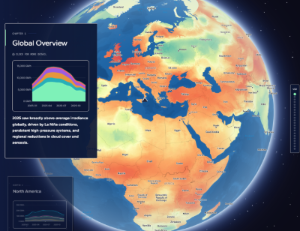
To see the 2025 annual irradiance anomaly in more detail, you can review our interactive global 2025 anomaly map - which will return the anomaly for any point in the world.
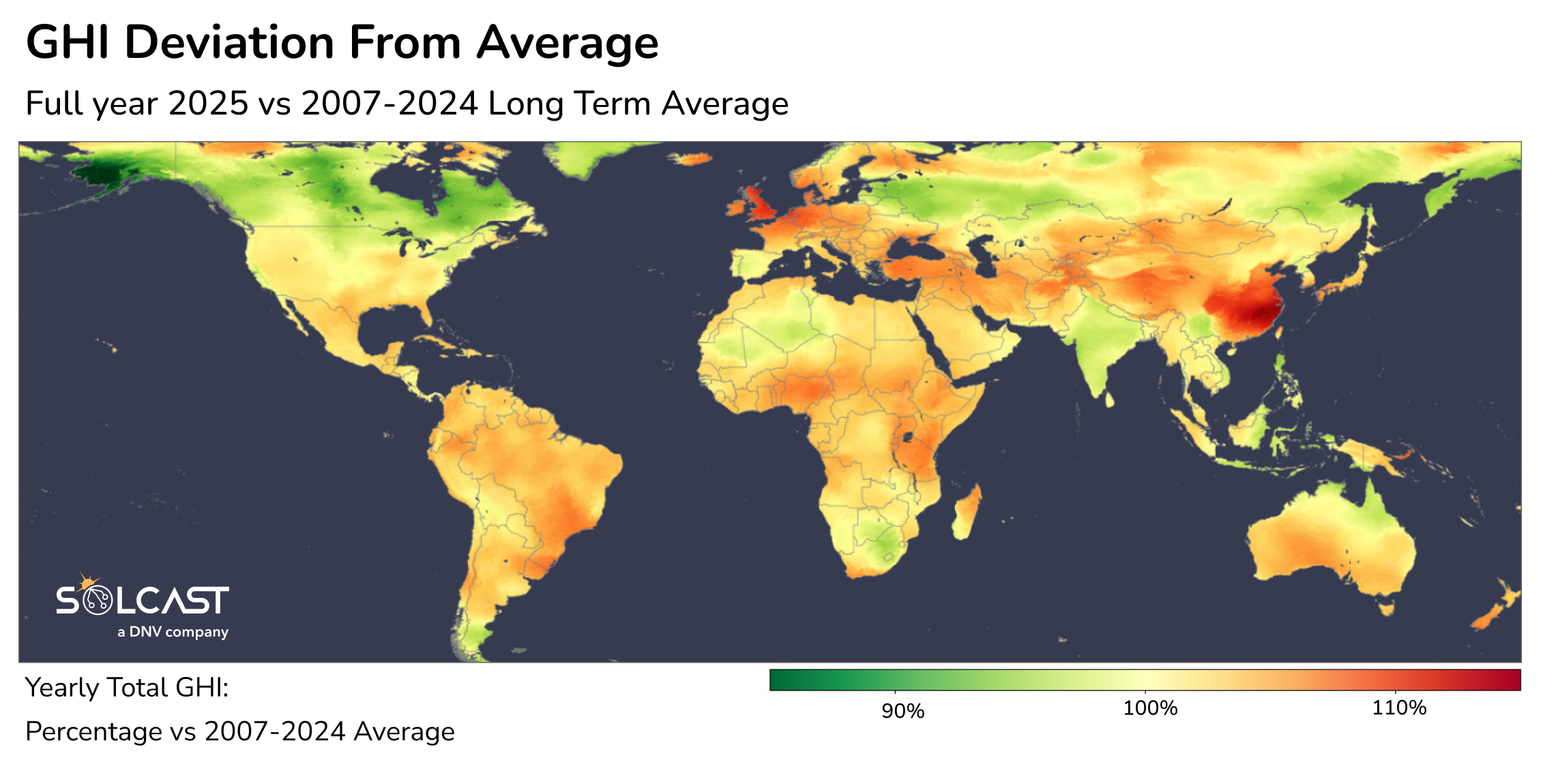
This produces a direct shift in the long-term reference values used to define a typical year.
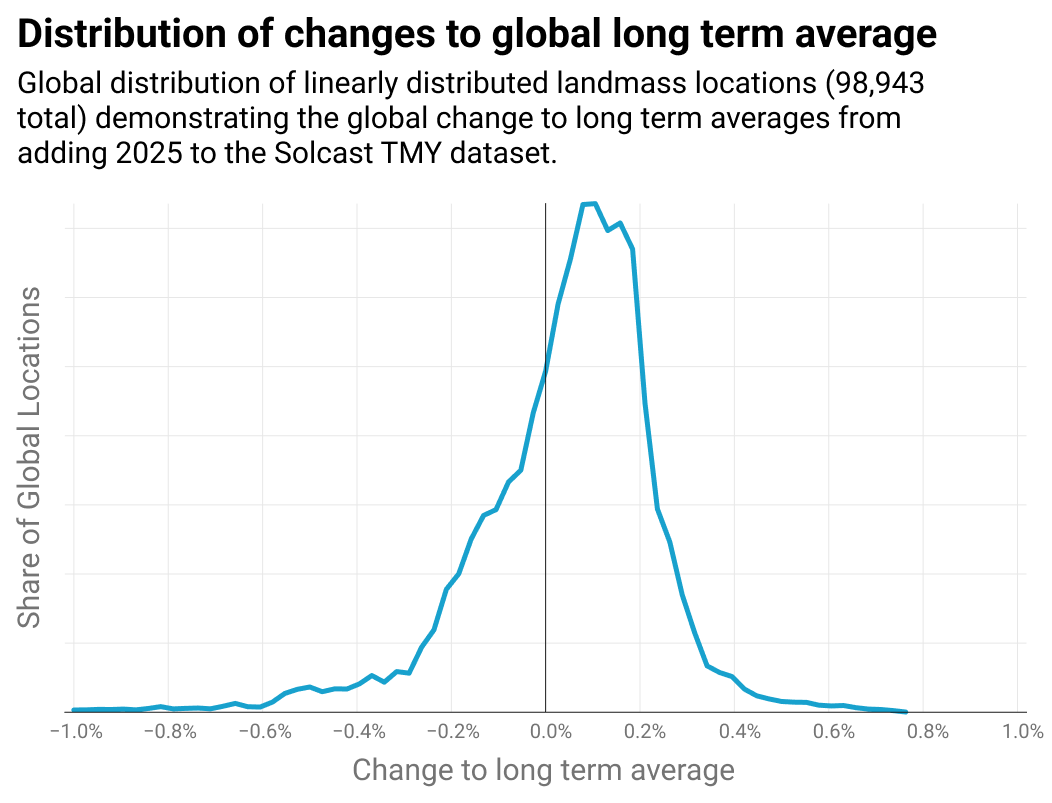
The effect is modest in proportional terms, because a single year only contributes one part of the updated long term average. However, TMY construction is sensitive both to the target average and to the ranking of available candidate months. In some locations, even a relatively small change in the target statistics can lead to a different combination of representative months being selected.
Summary
From today, Solcast TMYs will incorporate 2025 data. This means TMY outputs may differ from versions generated previously.
The reason is straightforward:
- there is more real data available to construct the TMY, and
- the long-term averages used to define “typical” have changed.
As the historical archive grows, Solcast TMYs continue to reflect the best available estimate of representative solar resource conditions based on the full observed record.