








Dr. Hugh Cutcher
December 24, 2025
Share this post
Solar generation potential across Europe in November showed a clear east-west divide, according to analysis using the Solcast API. Persistent low-pressure systems tracked across eastern regions, bringing widespread cloud and rain, while western and central Europe enjoyed clearer skies under higher pressure. The exception was the Atlantic seaboard, where Storm Claudia reduced irradiance to near or below average.
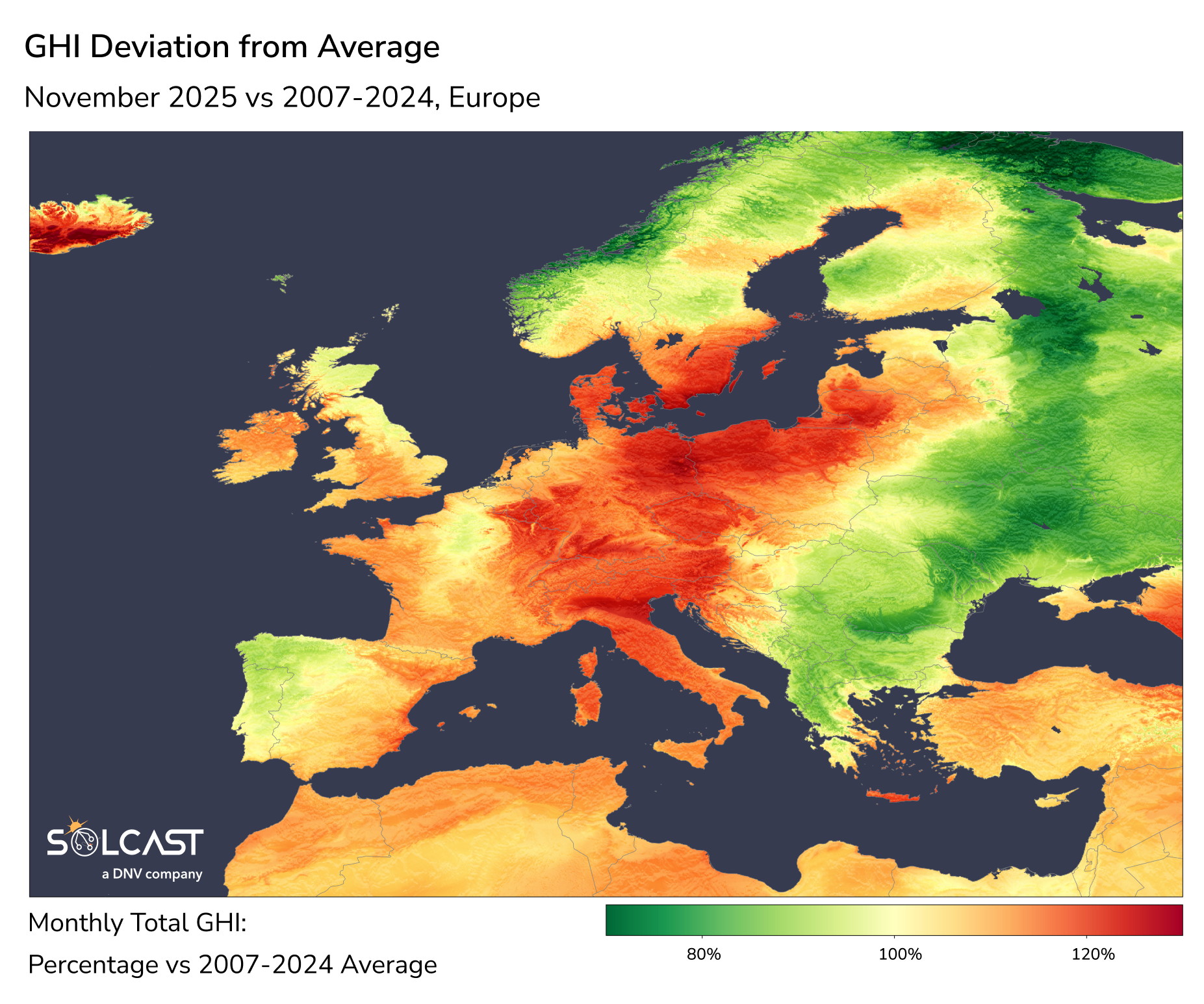
Eastern Europe experienced poorer than normal conditions for solar generation in November. Regular storms and frontal activity dominated, with Greece, Albania, Bulgaria, Romania, and Moldova recording irradiance about 15% below normal. Ukraine fared even
worse, down 20%, with daily averages falling from around 1 kWh/m² to 0.8 kWh/m². These reductions compound existing challenges for Ukraine’s power system amid ongoing conflict. Several low-pressure systems drove this pattern, culminating in Storm Adel late in the month. Adel brought flooding and hail to Greece and Albania, damaging infrastructure and reinforcing the cloudy trend across the region.
.png)
In contrast, much of Western and Central Europe experienced brighter conditions. A prevailing negative phase of the North Atlantic Oscillation shifted storm tracks southward, leaving northern areas drier and sunnier. Italy, Germany, Switzerland, Czechia, Poland, and Lithuania recorded irradiance 15–20% above average.
Italy was an interesting case. There was heavier-than-normal rainfall as well as severe weather outbreaks, consistent with the negative North Atlantic Oscillation that tends to bring wetter conditions around the Mediterranean. However, the rain events tended to be short and intense, alternating with sunny periods, allowing overall irradiance to exceed norms.
Conditions were less favorable along the Atlantic coast. Storm Claudia swept through Portugal and the British Isles during the second and third weeks of November, with cloud cover spilling into France and Spain. These regions saw irradiance near average or slightly below, with Portugal down by 5–10%. This localized reduction contrasted sharply with the gains seen further east, underscoring the strong regional variability driven by the tracks of low-pressure systems.
Track weather conditions, cloud movements, and irradiance-influencing factors that might impact your solar generation. Access bankable actuals and accurate forecasts when you sign up for a Solcast API toolkit. You can reach out to our team for an extended trial.