









Typical Meteorological Year
Download a statistically representative “typical year” file built from 15 + years of satellite data for long-term yield modelling.
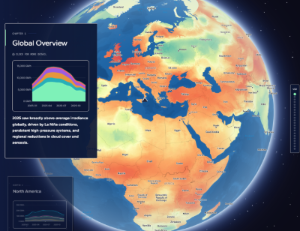
High-resolution & accurate historical solar irradiance and weather data built for solar












_Frame.png)





































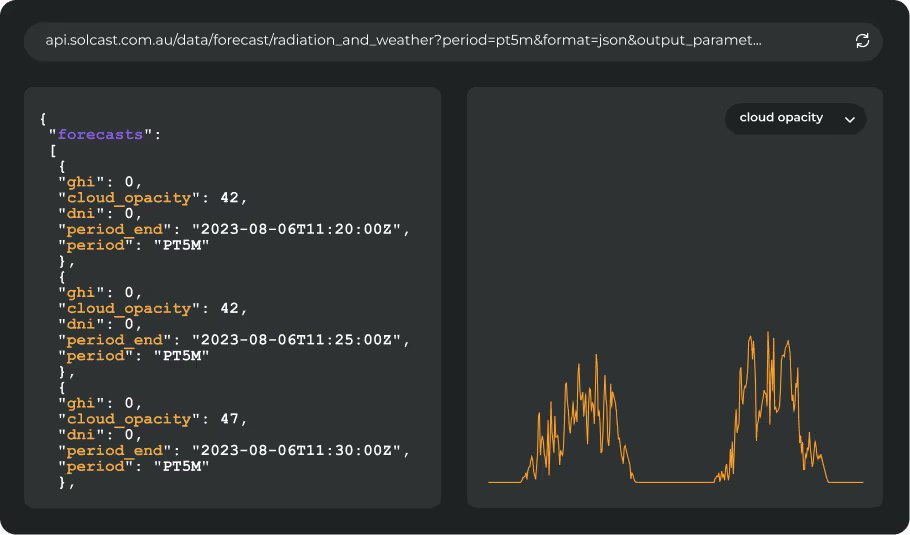
Access the world’s most accurate historical irradiance and weather data through our historical weather API. The Solcast API provides 20+ weather parameters tailored to solar energy applications, from 2007 to 7 days ago. Available instantly via synchronous JSON API or as an instant CSV web download.

The complete suite of irradiance and weather data required for effective monitoring, operation, and forecasting at your large-scale solar farm.

The complete suite of irradiance and weather data required for effective monitoring, operation, and forecasting at your large-scale solar farm
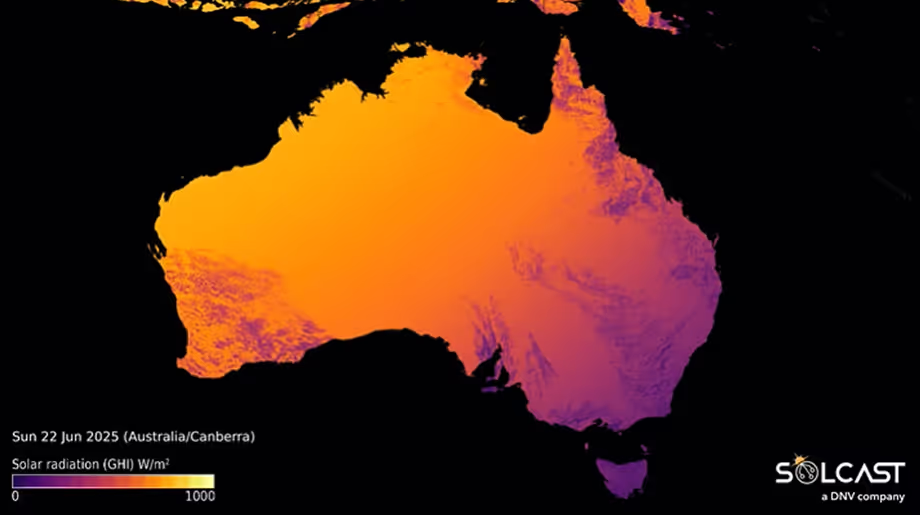
Designed for solar, from the ground up. Never rely on generic weather model data again. Solcast’s real-time, forecast, and historical weather API track real clouds at 1–2 km and 5-minute resolution. Irradiance and PV power data update every 5 minutes and are downscaled to 90-metre resolution, with explicit modeling of aerosol and albedo effects.
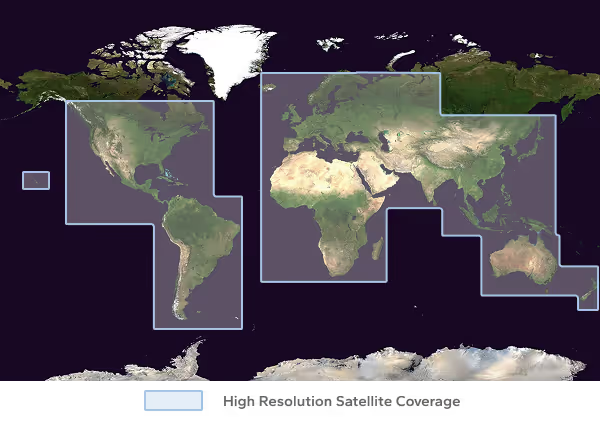
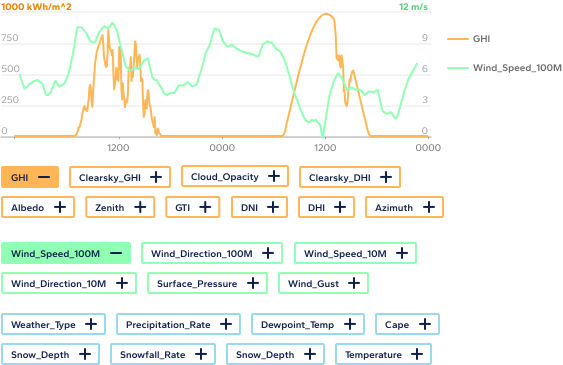
Access high-resolution weather and irradiance data for any global location via our historical weather API as part of the Solcast API.
Weather data from leading reanalysis datasets completes the full suite of 20+ parameters available at 5, 10, 15, 30 and 60 minute resolutions. Coverage from 2007 to 7 days ago.
Be confident that our data is fit for purpose.
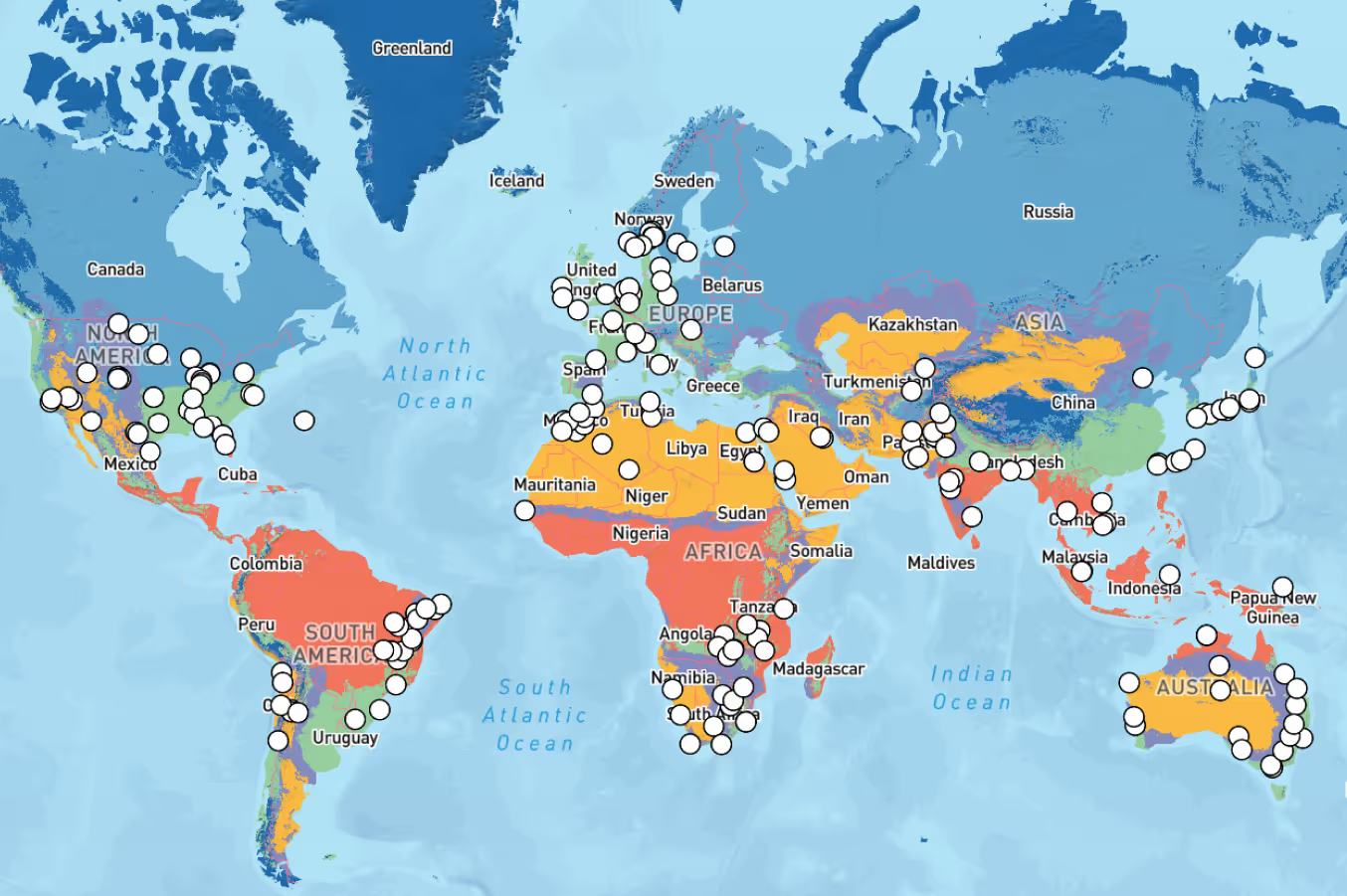
Our team of meteorologists and data scientists publish site-by-site validation so you can trust the performance of our historical weather API outputs.
Review global, regional and climate-zone results in our bankability validation.
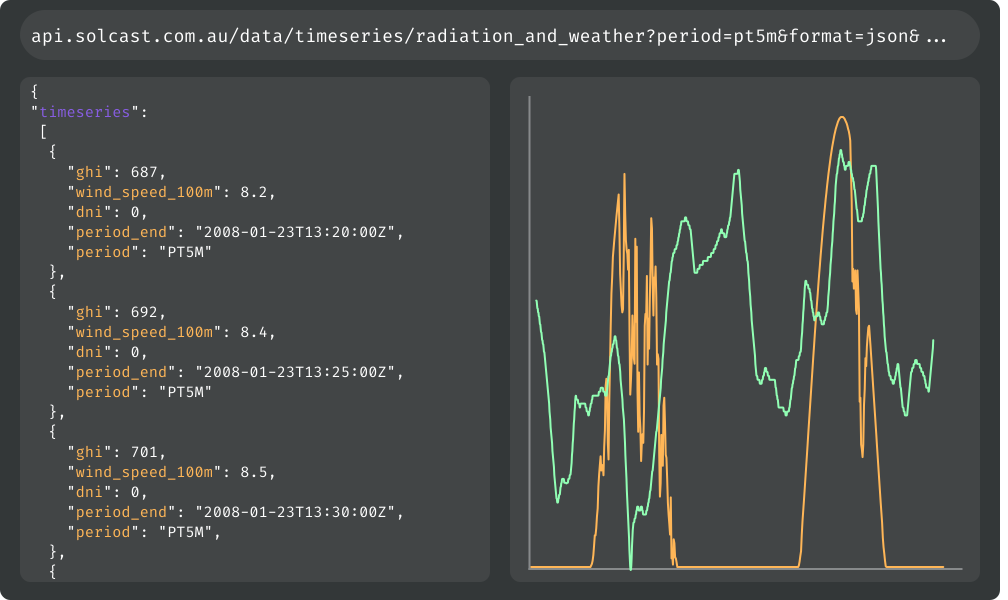
Our synchronous historical weather API returns JSON within 1–5 seconds per request.
Requests can be run in parallel up to your account’s rate limit.
Web downloads allow up to 20 locations at a time across multiple formats, including CSV ready for common simulation tools.
Geographic covereage
Global (note: far ocean and polar regions are coarser resolution)
Temporal coverage
January 2007 to 7 days ago (for past 7 days to present time and forecasts, use our Live and Forecast data)
Temporal resolution
5, 10, 15, 30 & 60 minutes (period-mean values)
Spatial resolution
90 meters (irradiance, PV power, snow soiling, cloud parameters, andother parameters across all regions)
Data parameters
The following data parameters are available.
+
Irradiance Parameters
+
Solar Parameters
+
Weather Parameters
Data access
API or Web download
Download wait time
API: synchronous requests. Web download: seconds.
File formats
CSV, JSON, PVsyst, SAM, TMY3
Data formats
Solcast standard, PVsyst (60 minute only)
Time zone
UTC, longitudinal, or user-specified fixed offset.
Forecasts are crucial in optimizing renewable power plants with predictive controls. Solcast’s forecasts, and the resulting decisions we make with them, are front and center for our operators.

On variable days with cloud movements, Solcast data outperforms our machine learning, providing the best results for trading models and VPP operations.

I love the ease of accessibility of data from Solcast, like the granular data and additional parameters used to understand irradiance.
We're pleased as actual and estimation graphs align showing great Solcast API accuracy. It helps detect production stops or behavior changes in our plants which prompts us to investigate errors on our end.
The Solcast API-first approach helps us to automate more of early resource assessments and run multiple options faster. Because while everything needs to be fast right now, it's gotta be accurate too!
We rely on Solcast live data from our first plant and continue as we grow. Combined with on-site sensors, Solcast data help us confidently monitor and understand our assets operationally.
As far as we know, there's no provider that can provide a more accurate forecast.

With Solcast's short-term forecast, we can act immediately and make informed decisions for our solar assets.
We manage multiple projects in both asset construction and development and we consistently find that Solcast TMY data is the most reliable as it provides median values across multiple datasets.
We just keep finding that the Solcast TMY data was the most consistent, the median value across multiple data sets. Others seemed to be sometimes high, sometimes low, that’s why we want to start using Solcast across all our projects, and we’ll get other data sources to add to that when we need it.
Adding Solcast's weather data in our hydrogen storage systems improved our control strategy that responds well to weather patterns.

On top of our sophisticated solar modelling, Solcast's accurate data has elevated what we already have and allowed us to expand to new geographies.

For us, Solcast's day-ahead forecast excel in accuracy and data granularity. It helps us with precise planning for tomorrow's dispatch, unlike other providers' once-daily data updates.
For high-level projects where data accuracy is crucial and there's a financial outcome, our dependence is primarily on Solcast data.
Solcast data is suitable for use to accurately predict project energy yield in energy assessment and for use in energy assessment for project financing purposes.
Solcast's "Estimated Actuals" closes the gap for our owned and third-party solar portfolios.
Accurate real-time and forecasted weather data is crucial for assessing plant performance and maximizing the value of clean energy assets.

We’ve seen significant improvement in our forecasts since we started using Solcast.

We use various historical irradiance data for monitoring purposes of power plants. When there is no financial benefit for us, we use the free weather sources. For high-level projects where data accuracy is crucial and there's a financial outcome, we primarily depend on Solcast data.
The API's ease of use is key for us. Our goal is to automate the process and we're able to query Solcast data when met station data is missing.
Solcast’s automated forecasts enhance our intraday market accuracy, providing the precision we need without constant manual updates. This real-time accuracy allows us to make better decisions as conditions shift.
Leave your details and one of our team will be touch.
Check how Solcast Historical Time Series compares with other irradiance and weather data.
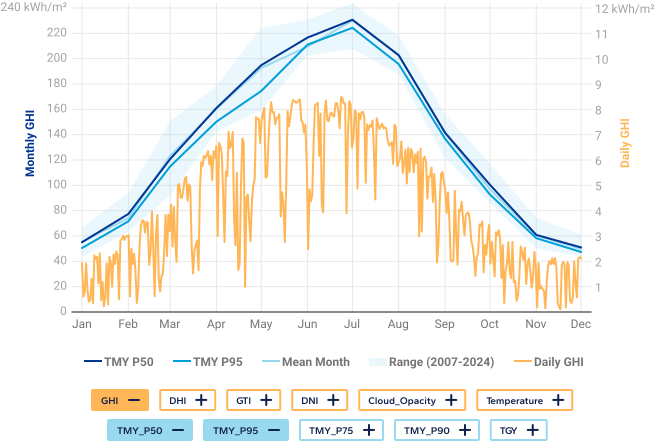

Download a statistically representative “typical year” file built from 15 + years of satellite data for long-term yield modelling.
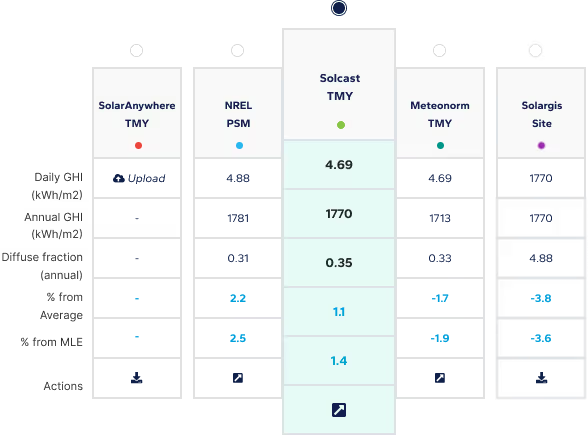
Compare multiple satellite data sets side-by-side to choose the most bankable resource file for your site.
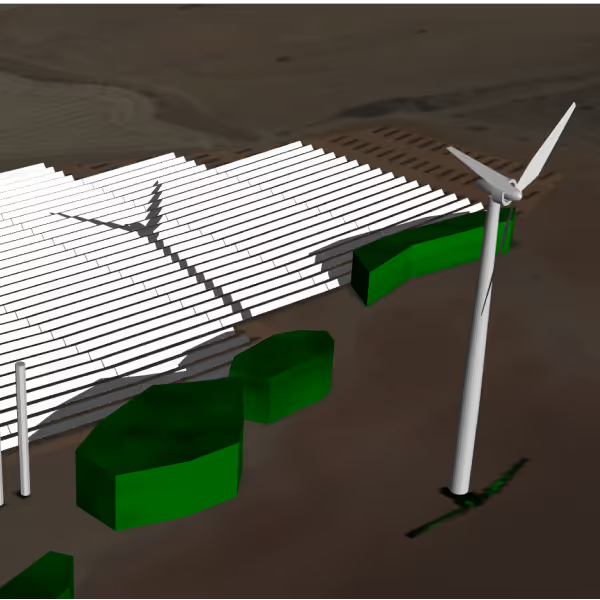
Bankable 3D-aware PV yield simulations, from automated layout to sub-hourly energy outputs, all in one streamlined tool.

What is a Historical Weather API?
A Historical Weather API provides past weather and irradiance data—such as GHI, DNI, temperature, cloud cover, and wind—delivered programmatically via JSON or downloadable files. Solcast’s Historical Weather API offers high-resolution, satellite-derived data from 2007 to 7 days ago, specifically tailored for solar energy applications.
What can I use historical weather data for?
Historical weather data is critical for solar projects, providing accurate resource assessment, long-term performance benchmarking and monitoring. Historical weather dat also enables gap-filling for missing sensor data.
How is time series data generated in the historical weather API?
Solcast uses an ensemble of global NWP weather data sources and historical satellite imagery to track clouds globally. Data is captured at native resolution from available data sources and downscaled to 90m based on terrain, aerosol and cloud data available.
How accurate is Solcast’s historical weather API?
Solcasts historical data has been validated as bankable by DNV in a global 207 site study. See the details in DNV's Bankability Report.
What locations are supported?
The Historical Weather API provides global coverage, with 90-metre irradiance resolution across all non-polar, continental regions and 27-kilometre resolution for other weather parameters and remote areas.
How does Solcast’s historical weather API compare with other providers?
The solcast API is built for the renewable energy industry. Some alternative weather APIs exist for general weather purposes, and some renewable energy data providers have APIs to access their data. Explore our historical and TMY data comparisons.
What time range does the historical dataset cover?
You can access data from January 2007 up to 7 days ago. This time horizon updates every 5 minutes For real-time and forecast data, use our Live Solar Data and Solar Forecast Data.


Subscribe to our newsletter to keep up to date with all the latest news.