









Harry Cheselwoods
March 19, 2026
Share this post
Kimber and HSU soiling models are now live in the Solcast API. Users can now estimate PV generation loss from soiling across historic, live, and forecast workflows using two industry-standard approaches, without having to assemble rainfall data separately, and in HSU’s case, particulate matter inputs as well.
Soiling is not an irradiance variable in the same way as GHI or DNI, but it directly affects how much irradiance reaches the solar cell. Dust and other particulates on a PV module can materially reduce generation. In some locations, losses can reach 30% or more without cleaning.
Solcast already provides the meteorological data used in PV generation workflows, including precipitation and particulate matter through PM2.5 and PM10. With Kimber and HSU now available directly in the API, users can move from estimating the presence of dust to estimating the energy impact of soiling itself.
Why this matters
For energy assessment teams, soiling is often too material to ignore and too variable to treat as a generic annual assumption. For asset operators, it can influence forecast accuracy, cleaning strategy, and commercial performance. In particular for remotely monitored assets, being able to explicitly model expected losses makes it possible to determine the difference between soiling related performance and developing performance issues that require maintenance.
In practical terms, better soiling estimates mean better yield models, more realistic historical assessments, and better operational forecasts. That is the value of modelling it properly.
This release was built primarily for energy assessment practitioners and asset operators, but it is useful anywhere a more accurate view of PV generation matters.
What the API returns
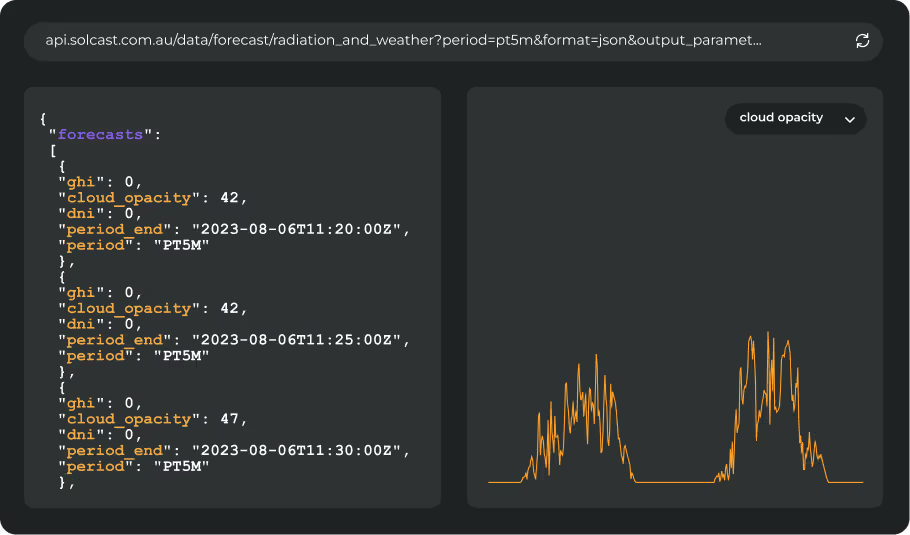
Both Kimber and HSU return a consistent output in the Solcast API: loss_fraction.
That means the result is directly interpretable regardless of model choice. If the API returns a loss_fraction of 0.10, that means soiling is estimated to reduce energy by 10% relative to a clean module.
The two models get to that number differently, and that difference matters. But the output is aligned so users can compare model behaviour more easily and integrate the result into existing workflows with less friction.
Kimber: straightforward, transparent, and widely used
The Kimber model estimates energy loss from soiling by assuming a constant daily accumulation rate. Loss builds over time and resets to zero when precipitation exceeds a user-defined cleaning threshold or when a manual washing event occurs.
That simplicity has a benefit. Real dynamic soiling ‘actuals’ are hard to get completely accurate, so using a single static soiling assumption removes the doubt around soiling rate accuracy. Kimber is easy to explain, easy to parameterise, and well suited to workflows where users want a stable, auditable estimate of soiling loss.
It also has a clear limitation. Because Kimber assumes a static accumulation rate, it can’t capture spontaneous significant soiling events, like wildfires or dust transport events. It does not attempt to capture hour-to-hour changes in aerosol transport or deposition. In some locations that is a reasonable simplification. In others, it can be too coarse.
In Solcast’s implementation, users do not need to source precipitation data separately. We populate the model with Solcast rainfall data, based on NWP ensemble models, and we look back over the previous year of rainfall and washing inputs to create valid initial conditions. Users can still specify key parameters such as rainfall cleaning thresholds, manual wash events, and the daily soiling loss rate.
HSU: a more dynamic view of soiling
The HSU model solves the same problem in a more dynamic way. Instead of assuming a fixed daily accumulation rate, it estimates soiling using rainfall and particulate matter over hourly or sub-hourly intervals.
That makes HSU more responsive to changing meteorological conditions. Where Kimber assumes a steady background build-up, HSU allows soiling behaviour to change as rainfall, aerosol concentration, and deposition conditions change.
For operational forecasting, that can provide a more realistic view of how soiling evolves through time. For assessment workflows, it offers an alternative where a fixed-rate model may be too blunt.
HSU also has trade-offs. It is still a model, not a site measurement. Its output depends on the quality and representativeness of the underlying inputs and assumptions, including deposition behaviour and cleaning thresholds. A more dynamic model is not automatically a better model for every use case. But it is often a better fit when short-term atmospheric variability matters.
In Solcast’s implementation, rainfall is populated automatically and PM2.5 and PM10 can also be populated using Solcast’s underlying meteorological datasets or a user provided dataset. Users can specify rainfall cleaning thresholds, panel tilt, aerosol deposition velocities for PM2.5 and PM10, and manual washing events. We also look back over the prior year of rainfall, particulate, and wash-event data to establish valid initial conditions.
The native pvlib implementation of HSU outputs a soiling ratio, which is equivalent to 1 - transmission loss. In the Solcast API, we convert that to loss_fraction so the output is consistent with Kimber.
Why we are offering both models
There is no single soiling model that is best for every application, and we believe in supporting engineers to do their own detailed modelling that they can control.
Kimber is straightforward and transparent. HSU is more responsive to time-varying atmospheric conditions. Those are different modelling choices, and they serve different needs.
We think it is better to expose those trade-offs directly than to hide them behind a single black-box output. Neither model removes site-level uncertainty. That is not what models do. What they do provide is a more explicit, defensible way to account for soiling than treating it as an unexamined fixed loss.
Availability and access
Kimber and HSU soiling models are available through Solcast Historic, Live, and Forecast product packages across all plans. Existing customers also have access to the new endpoints.
The endpoint structure is:
https://api.solcast.com.au/data/{historic|live|forecast}/soiling/{kimber|hsu}
For example:
https://api.solcast.com.au/data/historic/soiling/kimber
https://api.solcast.com.au/data/live/soiling/hsu
https://api.solcast.com.au/data/forecast/soiling/kimber
To get into the detail, review our API documentation for historic, live and forecast endpoints.
In the initial release, users can access hourly and sub-hourly data only. Historical monthly averages are not currently included.
We know monthly summaries are important for assessment workflows. Users can derive those averages from the returned time series today, and native monthly averages are planned for a future update.
A practical note on power model integration
These soiling models are not currently integrated into Solcast's Advanced PV Power or Rooftop PV Power models.
For now, users need to apply the returned loss_fraction as a separate step. That is straightforward and is implemented to effective double counting of soiling for users already explictly modelling soiling themselves.
If your workflow already includes non-snow soiling assumptions in loss_factor, site configuration, or apply_dust_soiling, those should be removed or set to zero before Kimber or HSU outputs are applied.
For Rooftop PV, soiling can be applied by multiplying pv_power_rooftop by (1 - loss_fraction).
For Advanced PV Power, users can either multiply the power output by (1 - loss_fraction) after the fact, or supply the value using the apply_dust_soiling API parameter so it is handled within the power modelling step. If you take that route, monthly average dust soiling values at the site should be set to 0, and no separate soiling adjustment should be sent in the same request.
A better way to model a real loss mechanism
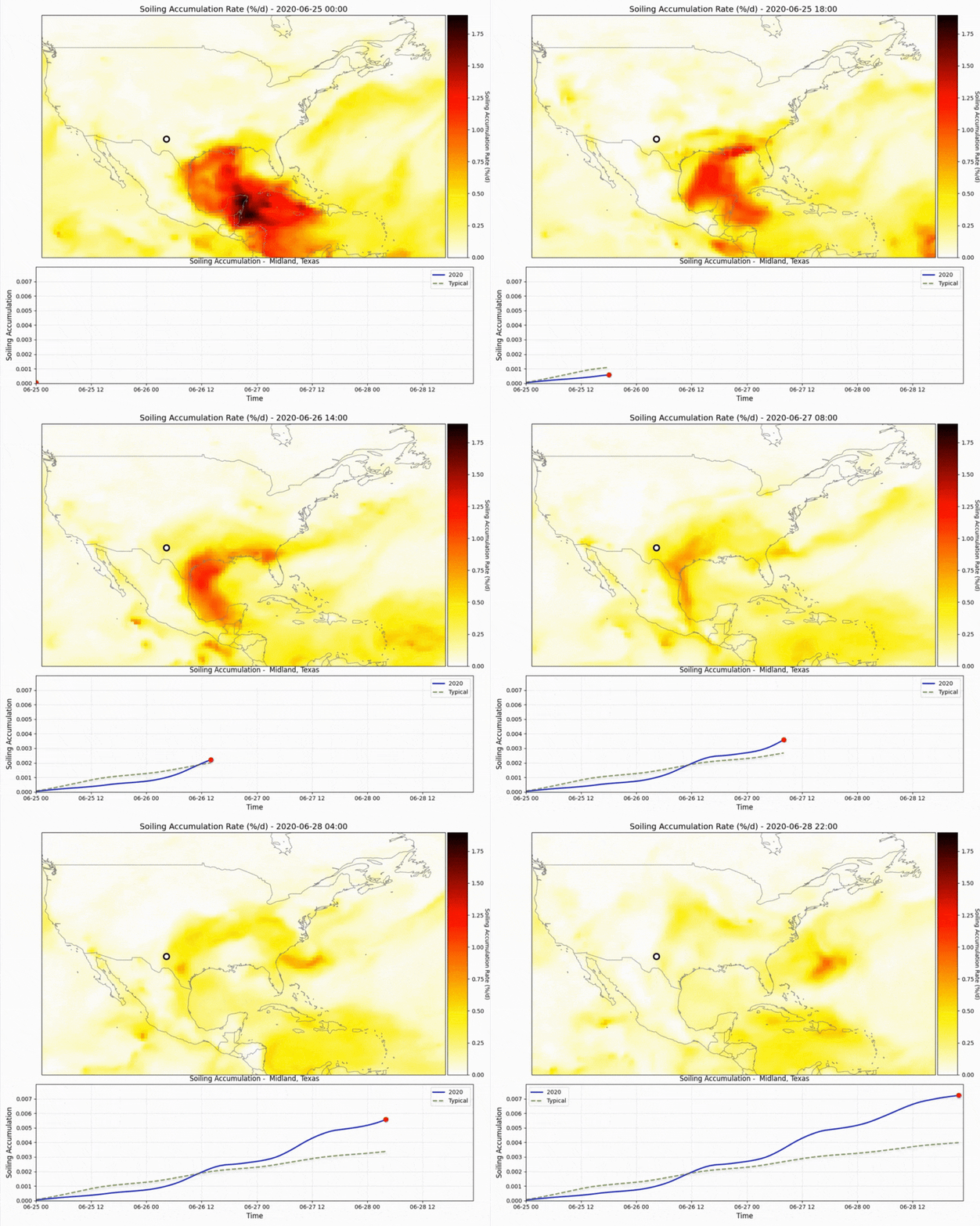
Soiling is not a second-order issue everywhere. In some climates and conditions, it is a first-order loss mechanism. Treating it as a flat assumption may be convenient, but it is not always good modelling. The first example in this article shows a dust transport event, with Saharan dust traveling across the atlantic and increasing soiling rates in the US southwest. Static soiling assumptions cannot capture these kinds of losses, and distract from the real performance conditions of your assets.
By adding Kimber and HSU to the Solcast API, we are making it easier to estimate soiling loss with methods the industry already understands, while reducing the work involved in sourcing and preparing supporting meteorological inputs.
If you are already using Solcast for yield assessment, asset operations, or generation forecasting, you can now bring soiling into the same API workflow with a consistent, model-aware output.
References
HSU model
M. Coello and L. Boyle, “Simple Model for Predicting Time Series Soiling of Photovoltaic Panels,” IEEE Journal of Photovoltaics. DOI: 10.1109/JPHOTOV.2019.2919628
Kimber model
A. Kimber, L. Mitchell, S. Nogradi and H. Wenger, “The Effect of Soiling on Large Grid-Connected Photovoltaic Systems in California and the Southwest Region of the United States,” 2006 IEEE 4th World Conference on Photovoltaic Energy Conference, Waikoloa, HI, USA, 2006, pp. 2391–2395. DOI: 10.1109/WCPEC.2006.279690